
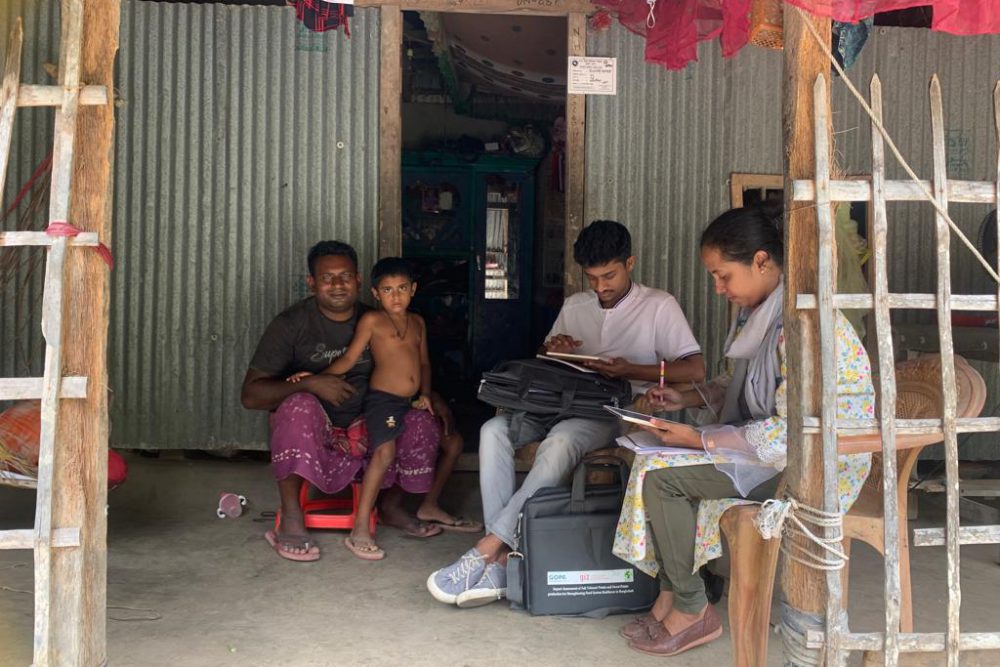
Commissioned by GIZ and managed by GOPA Worldwide Consultants, this project assessed the adoption and impact of salt-tolerant potato and sweet potato varieties to strengthen food system resilience in saline-prone southern Bangladesh.
Southern Bangladesh plays a critical role in the country’s food security but faces increasing threats from climate change, including rising soil salinity and extreme weather events. These environmental stressors have led to declining crop yields and heightened food insecurity, particularly for smallholder farmers. In response, the International Potato Center, in collaboration with the Bangladesh Agricultural Research Institute, developed salt-tolerant potato and bio-fortified orange-fleshed sweet potato varieties designed to perform in saline conditions. These new varieties were introduced in women-owned home gardens and accompanied by nutrition education and food demonstrations using the Community Nutrition Scholar model.
Our experts conducted a combined adoption and impact assessment to evaluate the effectiveness of salt-tolerant potato and bio-fortified orange-fleshed sweet potato varieties as well as improved potato varieties. We explored (dis-)adoption dynamics and potential spillover effects, alongside smallholders’ perceptions, decision-making processes, and constraints to adoption.
The impact assessment employed a retrospective quasi-experimental design, based on the intervention’s implementation from 2018 to 2020. Treatment and control groups were established through desk research, survey data analysis, and consultations with key stakeholders. A mixed-methods approach combined household surveys with focus group discussions and key informant interviews, generating both quantitative and qualitative insights.
The assessment provided evidence on how the adoption of salt-tolerant varieties influenced household diets, productivity, and income. It also identified key adoption pathways and barriers, offering valuable lessons for scaling climate-resilient and nutrition-sensitive agricultural innovations in similar contexts.
Find out more about the project here.